


It can be challenging to identify what is driving Donald Trump one month after the US and Israel's campaign of military action on Iran.
However, it remains evident he has his attention fixed on the global crude markets.
A word – or tweet – from the American leader about his plans once would spark significant moves in oil prices, as traders seized upon signals the conflict could worsen or de-escalate.
But in the last week, traders appear to be becoming increasingly doubtful about the impact of his comments.
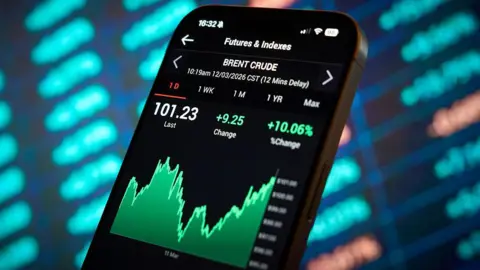
Crude oil was valued at around $72 a barrel prior to 28 February, when the strikes on Iran began.
Last week, it reached a high of $118 a barrel on 19 March and by Friday afternoon was sitting at slightly under $112 – markedly higher than its pre-war price.
Here are several examples from the past month where Trump and the markets appear to have reacted to each other – with varying effects.
Use the navigation button to proceed to the next slide.
"Oil prices have become a proxy for wider geopolitical and economic uncertainties, surging when Trump's tone becomes confrontational and declining when his rhetoric becomes more conciliatory," says one investment manager.
He states that markets are rightfully reactive to those signals, given the significant macroeconomic threats that come with increasing oil prices.
"Investors are trying to evaluate authentic volatility," he comments. "The markets can look nervous or confused, but what they're actually doing is navigating event risk in the moment, with oil positioned directly at the centre of that."
But, it can be difficult for investors to decide how to trade, particularly because some of Trump's remarks seem intended to affecting oil prices, instead of articulating policy, argues another investment advisor.
"As they say, the first casualty of war is truth," he observes. "I suspect much of the communication back-and-forth around diplomatic progress, and the opposite, very much are aimed at simply moving the market price of oil."
Investor Response Become Increasingly Subdued
On a recent Thursday, minutes after US equity markets experienced their largest decline since the outset of the Iran war, Trump announced discussions with Iran were going "very well" and he was postponing military strikes on Iran's oil facilities until at least 6 April.
Yet, the oil price continued to rise.
One head of FX strategy says that market reactions are "becoming more muted" because of the "wide divergence" between Trump's optimistic statements and the lack of acknowledgement from Tehran.
"Considering the optics, many market watchers can not see an quick conclusion to the conflict and financial markets continue to be nervous."
Another investment director notes markets have also grown used to Trump "repeatedly shifting position at indications of geopolitical, stock market or market turmoil".
"There is a amount of wariness, or even downright cynicism, emerging at the fringes," he adds.


